By the CieloGrid Weather Team3 min read
In this guide
"40% chance of rain" is one of the most misunderstood phrases in everyday life. Surveys have found that many people think it means rain for 40% of the day, or over 40% of the area. Neither is correct. Once you understand what the number really measures, it becomes a powerful planning tool.
The definition
The probability of precipitation (often shortened to PoP) is the chance that measurable precipitation — typically at least 0.1–0.25 mm, depending on the forecaster — falls at a specific location during a specific period, such as an hour, a three-hour block or a day.
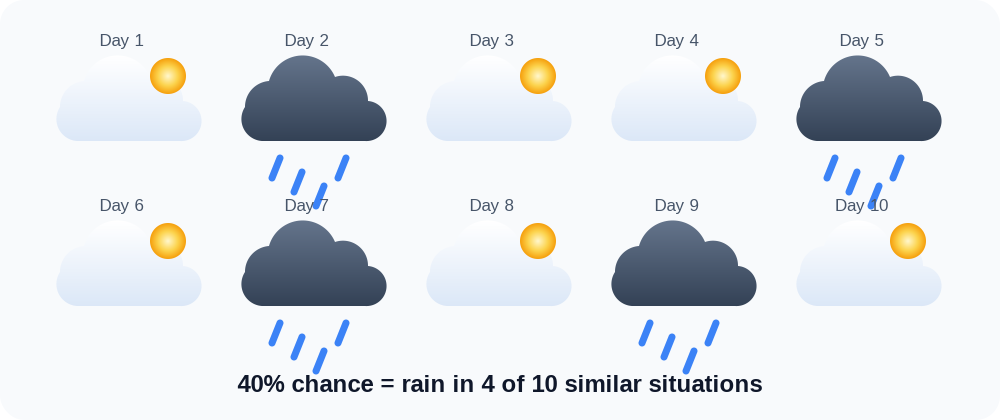
A 40% chance of rain means: given everything the forecaster knows, in situations like this one, rain falls at your location about 4 times out of 10.
Where the number comes from
Traditionally, many forecasters describe PoP with a simple relationship:
PoP = Confidence that rain will form × Fraction of the area expected to get rain
If a forecaster is 80% confident that showers will develop and expects them to cover half the region, the PoP is 0.8 × 0.5 = 40%. The same 40% could also come from being 40% confident that rain will cover the whole area. This is why the number on its own cannot tell you whether you face a widespread, uncertain rain or a certain but patchy one.
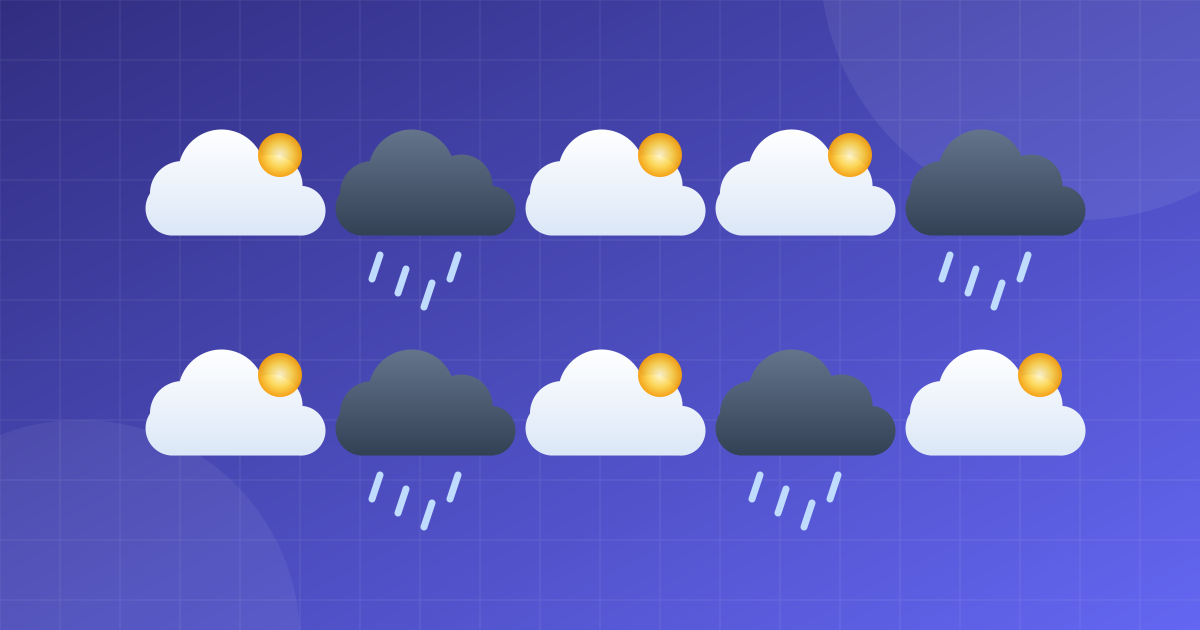
Modern forecasts — including the data behind CieloGrid — also come from ensemble forecasting. A weather model is run many times with slightly different starting conditions. If 12 of 30 runs produce rain at your location in a given hour, the rain probability is about 40%. Statistical corrections then calibrate the numbers against how the models actually performed in the past.
Common misunderstandings
- "It will rain for 40% of the day." No — the period could see one 20-minute shower or a long spell of rain.
- "40% of the area will get rain." Not necessarily; coverage is only one possible ingredient.
- "A low chance means it won't rain." A 20% chance is still one in five. Over a week of 20% days, rain on at least one day is more likely than not.
- "High probability means heavy rain." Probability says nothing about intensity. Always check the amount.
Combine chance with amount and timing
The most useful forecasts pair the probability with the expected amount and the hour-by-hour timing:
| Situation | How to read it |
|---|---|
| 80% chance, 1 mm | Almost certain light rain — a jacket is enough |
| 30% chance, 25 mm | Unlikely, but if a storm hits you it will be heavy |
| 60% chance, 15 mm, mostly 3–6 pm | Plan outdoor activities for the morning |
| 20% chance every hour all day | Small risk each hour; the chance of some rain during the day is much higher |
That last row matters. Hourly probabilities do not add up neatly, but several modest hourly chances together can mean a fairly high chance that it rains at some point in the day.
Why showers make probabilities tricky
In the monsoon and during pre-monsoon thunderstorms, rain often falls in showers just a few kilometres wide. A forecaster may be confident that storms will form across a region but cannot know which neighbourhoods they will hit. The result is a moderate probability over a wide area — and the experience that "it poured across town but stayed dry here". Steady rain from large systems, such as a depression or a cyclone remnant, tends to come with higher, more reliable probabilities.
Turning probability into decisions
The right threshold depends on what is at stake:
- Low cost if you get wet (a walk, running errands): you might act only when the chance is above 50–60%.
- High cost (an outdoor event, drying harvested crops, concrete work): consider acting at 20–30%, especially if the expected amount is large.
- Safety-critical (trekking, travel through flood-prone areas): pay more attention to official warnings and the potential amount than to the probability alone.
Key takeaways
- Rain probability is the chance of measurable rain at a point during a period — not the share of time or area.
- The same percentage can come from uncertain widespread rain or certain but patchy showers.
- Always read probability together with rainfall amount and timing.
- Choose your own threshold based on how costly getting caught by rain would be.
Frequently asked questions
What does a 30% chance of rain mean?
It means that in similar weather situations, measurable rain fell at that location about three times out of ten during the forecast period. Most of the time it stays dry, but rain is a real possibility.
Is 40% chance of rain a lot?
It is a moderate chance — closer to a coin toss than to a dry day. Whether it is "a lot" depends on the expected amount and on how much getting wet would affect your plans.
Why did it rain when the forecast said 10%?
A 10% chance still means rain happens about one time in ten in similar situations. Isolated showers can also hit small areas that the forecast could not pinpoint.
This guide is general information, not a substitute for official warnings. For severe weather, always follow your national meteorological service and local authorities.